
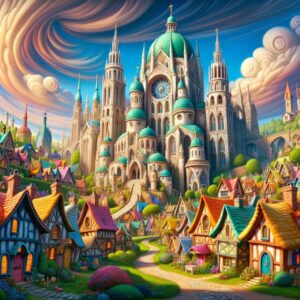
 Once upon a time, in a land not too far from our own hearts, where coffee flowed more abundantly than water and where the internet was considered a basic human right, there existed a peculiar village named Whimsicton. This village was known far and wide for its grandiose cathedral, which towered above the cottages like a lanky teenager at a kindergarten party. However, despite its impressive architecture, the cathedral had a little problem—it was, for lack of a better word, a tad disorganized.
Our story begins with the protagonist, Ellie—a spunky librarian with a penchant for mismatched socks and a secret talent for yodeling. Ellie was Whimsicton’s most ardent non-attendee of the cathedral’s services, not out of disbelief but simply because she found the sermons as engaging as watching paint dry on a rainy day. However, her life was about to take a turn more unexpected than finding out your blind date is actually a distant cousin.
One day, while Ellie was organizing a particularly rebellious section of the library that insisted on mixing fiction with non-fiction, she stumbled upon a dusty, old book titled “How Organized Religion Failed: A Comedic Tale.” Intrigued and amused, she decided to give it a read, not realizing it would catapult her on a journey of epic proportions.
The book was filled with tales of disorganized deities who misplaced their thunderbolts, archangels who forgot the words to important celestial anthems, and saints who accidentally patroned the wrong causes. Each story was a hilarious testament to divine disarray, but Ellie couldn’t help but see the underlying message—a call to embrace the chaos and find meaning in the mess.
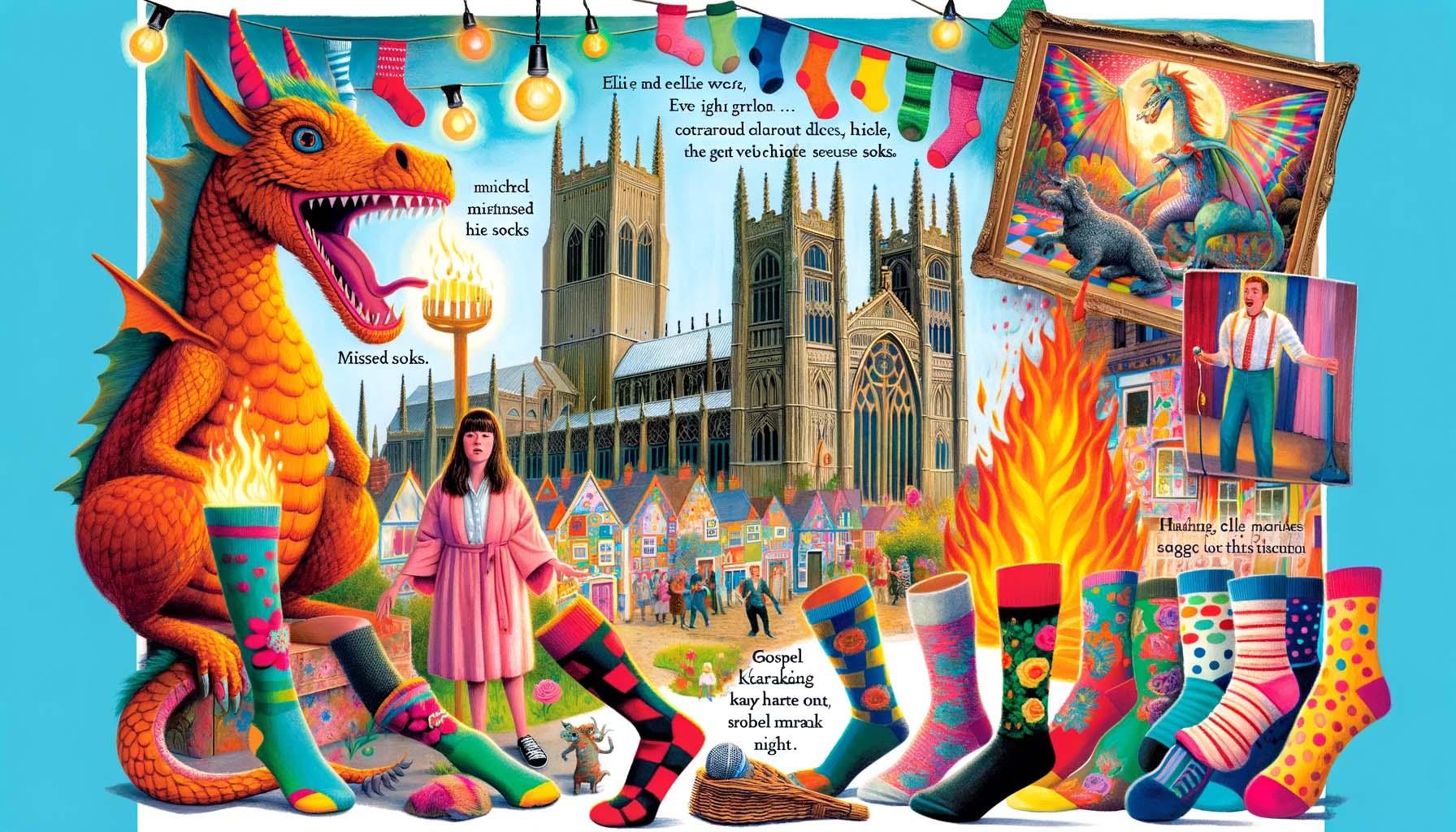
Inspired, Ellie embarked on a quest to bring laughter and light-heartedness to the cathedral of Whimsicton. Her first act was to organize a “Mismatched Socks Sunday,” where villagers were encouraged to attend service wearing their most outrageous socks. The event was a hit, especially when Father Theodore showed up in socks featuring neon flamingos playing beach volleyball.
Next, Ellie transformed the traditional and somewhat snooze-worthy Sunday sermons into interactive storytelling sessions, complete with pop culture references and modern slang. “And lo,” Father Theodore began one Sunday, “Moses parted the Red Sea with the same ease and swagger as one swipes left on a dating app.” The congregation roared with laughter, a sound so rare and delightful that even the stained-glass saints seemed to smile.
However, not all was smooth sailing. Ellie faced resistance from the Council of Elders, a group so ancient they considered the Renaissance a youthful indiscretion. They were appalled by the changes and plotted to restore order and solemnity to their services.
Their plans, however, were as effective as a chocolate teapot, especially after Ellie introduced “Gospel Karaoke Night,” turning the cathedral into a place of joyous, if slightly off-key, celebration.
As Ellie’s influence grew, so did her understanding of what truly mattered. It wasn’t about whether religion was organized or disorganized, but about the community it fostered and the kindness it spread. Her journey of self-discovery led her to appreciate the beauty in imperfection and the strength in forgiveness.
The climax of our tale occurred during the “Festival of Forgiveness,” a whimsical event Ellie created to celebrate acceptance and love. Villagers wrote down their grudges on pieces of paper,  only to feed them into a giant papier-mâché dragon, which was then set ablaze in a spectacle of flames and fireworks. As the dragon burned, so did their animosities, lighting up the night sky with a promise of new beginnings.
In the end, the cathedral of Whimsicton became more than just a place of worship; it was a beacon of unity and laughter. Ellie, with her unmatched socks and her ability to find humor in the mundane, had shown everyone that it’s okay to be a little disorganized, that life is more enjoyable when you can laugh at yourself and with others.
Our story concludes not with a traditional “happily ever after,” but with the entire village, including the once-stern Council of Elders, dancing under the moonlight, their laughter echoing through the night. It was a heartwarming resolution that proved sometimes, in order to find what you’re looking for, you need to embrace the chaos, wear your quirkiest socks, and remember that the journey is just as important as the destination.
And so, in a world that often takes itself too seriously, the tale of Ellie and the disorganized cathedral of Whimsicton serves as a whimsical reminder that laughter is the universal language of the soul, and in the end, acceptance and joy are what truly unite us.